Vocal Ensemble Workshop Session 2: Saturday Feb 14 3:30-5:00pm

In our first session, we covered

  • the fundamentals of getting acquainted with the voice

  • somatics of singing and breathwork

  • holding a durational pitch with sine wave drone

  • vowel sounds + overtones/harmonics

  • adding the 5th and 4th intervals of the scale

  • some basic ensemble motion and coordination

In our next session, we will cover

  • tuning with the mask & inner ear + memory

  • vocal strengthening/belting: volume, attack, sustain

  • learning the 2nd, 4th, and 5th intervals

  • glissando and portamento between notes

  • microtonal shimmering, beats, and blurring

  • continuing ensemble motion and coordination

Exercises for the week to prepare for Session 2:

  1. Continue practicing holding long duration notes with a reference pitch. Work on ‘stacking’ the notes by pausing to breathe for long notes, one after the other.

  2. Work to hear your tuning and detect beats. Use singing from the mask (‘ng’ hum) and inner ear to move closer to the reference tone.

  3. With your practice, add in changing vowel sounds (ohh to eee to ahh to ooh). Try to hear overtones and harmonics.

  4. Extend the practice to sing the 5th and 4th intervals along with your reference pitch as the fundamental. For example: with a drone of D, the 4th is G and the 5th is A. Try to nail your tuning by adding playback reference for those notes as well, if needed.

  5. Now move between notes, starting with the fundamental and improvising between the 4th and the 5th. Experiment with glissando (sliding into the notes) and portamento (moving directly to each note without sliding). Alter tempo and keep playing with your timbre- change vowel sounds, work with volume, tongue placement, lip shape, jaw, and throat opening.
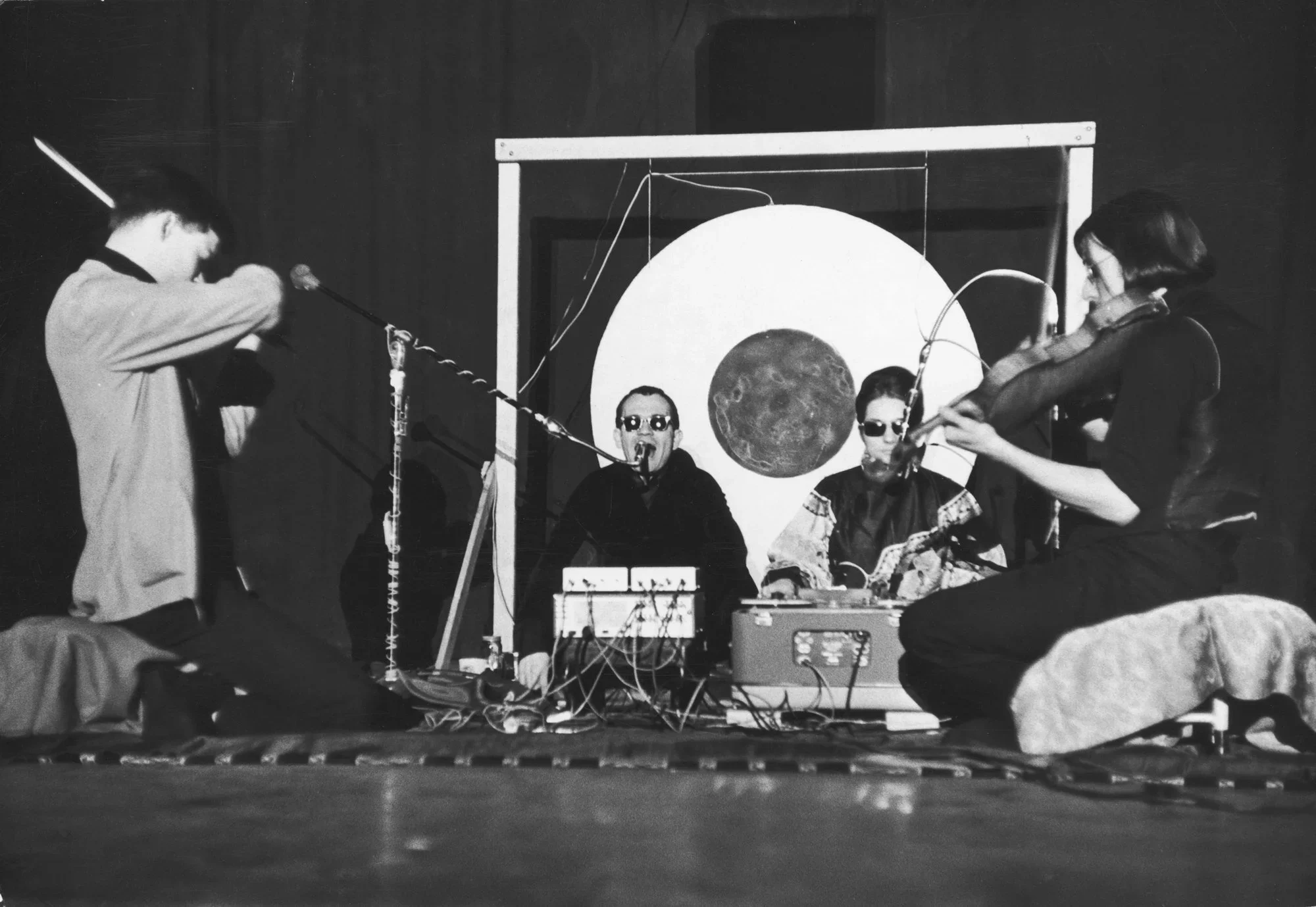
La Monte Young’s Theater of Eternal Music was a 1960’s collective that he formed to explore the phenomenological aspects of long duration performances by using influences from Hindustani raga and environmental sound, such as the hum of electrical wires near where he grew up in Idaho, and the 60 Hz hum of the aquarium in his home. He played with pitches at distances from the fundamental drone using a special tuning system (we won’t worry about that for now) that accentuated certain intervals to create an open, dream-like, ‘eternal’ feeling- such as the 2nd, the 4th, the 5th, the ‘septimal 7th’, etc. The group experimented with using strings, horns, the voice, and eventually electronic sine waves, which influenced Young’s later work with the Dream House, the Well-Tuned Piano, and other works…not to mention the influence on Young’s collaborator John Cale who brought these ideas to The Velvet Underground.

These works and Young’s philosophy formed a major strain of modern music in the 20th century that rippled into classical, rock, punk, underground, electronic, dance music, visual art, curated environments, and advances in musical tuning systems. La Monte is currently 90 years old and continues to compose; his long-time partner, the great visual artist/musician Marian Zazeela, passed in 2024 at the age of 83.

Here are links to two examples of his early work that are related to our vocal ensemble practice:

‘Pre-Tortoise Dream Music’- https://youtu.be/aLitnrAd9jg

Here the ensemble works with their instruments much in the way our early sessions will explore durational singing in reference to a fundamental drone, with certain intervals that can be added to form rich, complex, and dynamic chords- not to create melodies, but to solely use harmony and timbre as the core elements. You can hear the hypnotic, trance-like, timeless quality of the sound but also notice the subtle changes occurring throughout so that there is a non-linear motion to the music.

La Monte Young and Marian Zazeela singing together with sine wave- https://youtu.be/2lrrqq3NXgk

Here is a great example of singing somewhat similar to what we are working on in our initial sessions. La Monte’s long-time partner Marian Zazeela (a great visual artist as well: calligrapher, light artist, and installation designer) holds the fundamental pitch along with a sine wave reference tone. La Monte sings with her by matching the drone and moving to other intervals, such as the 4th, 5th, and septimal 7th, in different combinations, which becomes quite melodic. You can hear the influence of Hindustani raga singing on his style (they both trained with master vocalist Pandit Pran Nath for many years), and you can hear him occassionally try to dip to very low octaves. But notice how the music isn’t trying to ‘go anywhere’ or have any sense of linear melody- the harmonies and duration themselves make up the music.